00:00 Tribes
04:45 Northem Forests
06:28 The Greatest King of the Warriors
13:15 Mháthair Mhór
15:05 Alesia
19:36 Vercingetorix Deditur
22:15 1.000.000
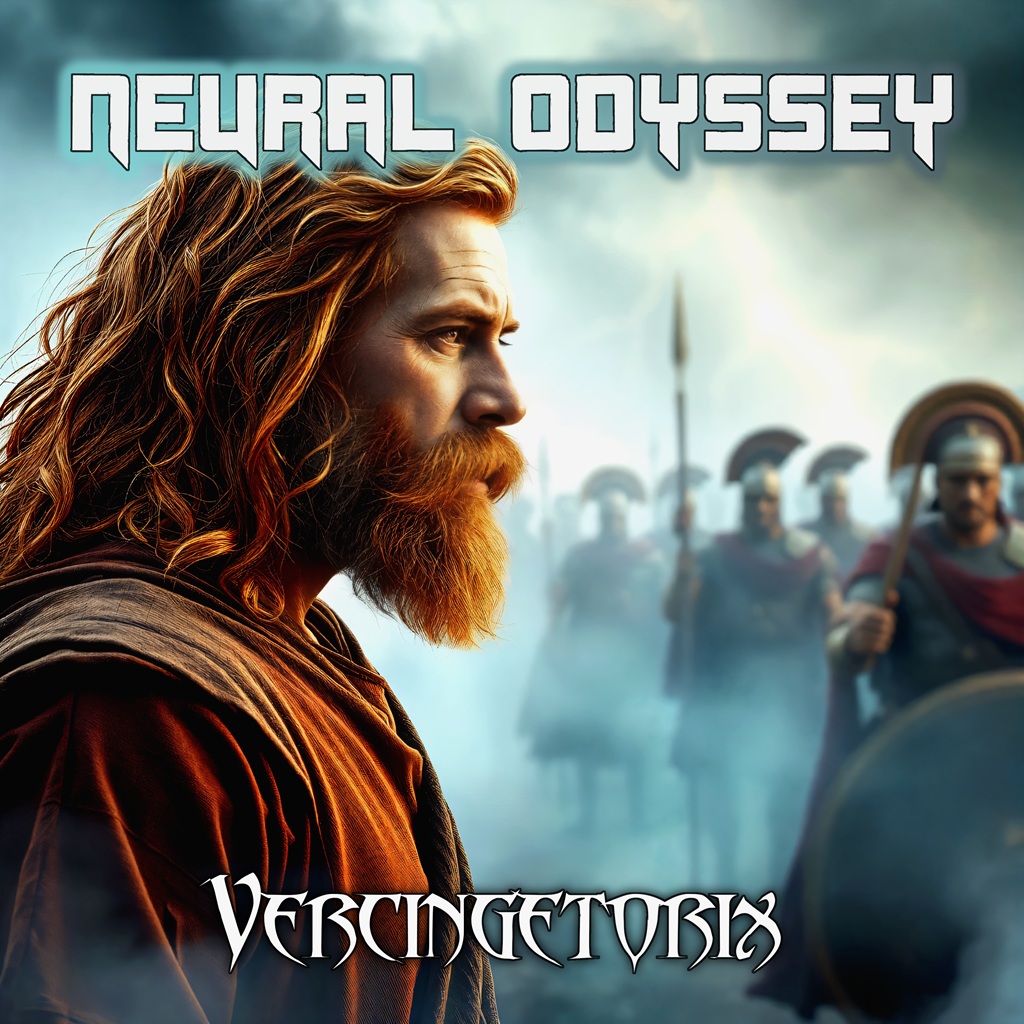
Vercingetorix is a suite of almost 28 minutes, divided into seven sections and conceived as a single, predominantly instrumental musical journey through the life and fate of Vercingetorix: from his origins and formative years in the Celtic world of Gaul to the revolt against Rome, the defeat at Alesia, his surrender, and the epilogue.
Rather than recounting his story in a strictly chronological manner, the suite seeks to evoke his world, alternating different atmospheres, themes, and moments through chapters of a single narrative.
Tribes | 00:00
“Tribes” introduces the world of the Celtic peoples of Gaul: a reality fragmented into numerous tribes, with different identities and interests, yet bound together by a common culture. A complex society that was, in many respects, technologically advanced for its time, with extensive knowledge of metalworking, skilled craftsmen, and artists capable of developing an original and immediately recognizable visual language. A world of warriors, farmers, merchants, and specialists, connected through a vast network of trade and far removed from the simplistic image of the “barbarian.”
It is the world in which Vercingetorix was born and raised, and from which, years later, he would attempt to bring forth something that until then had seemed almost impossible: a united Gaul.
Northern Forests | 04:45
It is a brief instrumental interlude, with classical and contemplative tones, serving as a bridge between the introduction to the Celtic world in Tribes and Vercingetorix’s entrance into the narrative.
For a few minutes, the epic dimension remains in the background, leaving space for the landscape: the great forests of Gaul become an imagined setting, silent and almost suspended in time. It is a moment to breathe before the suite changes pace once again and History begins to take over.
The Greatest King of the Warriors | 06:28
The third section marks Vercingetorix’s entrance into History. “The Greatest King of the Warriors” reflects the meaning traditionally attributed to the name Vercingetorix: “the great king of the warriors.”
The section opens with a classical and orchestral crescendo, becoming progressively more solemn and epic, symbolically accompanying the rise of the Arvernian leader and his attempt to unite numerous peoples of Gaul against a common enemy.
The musical progression ultimately leads to a distinct transformation: the orchestra gives way to a more powerful and aggressive symphonic metal component. This is the moment when the narrative shifts from the leader’s rise to open conflict. Vercingetorix and the Gallic coalition enter into direct confrontation with Rome and the legions of Julius Caesar.
Mháthair Mhór | 13:15
“Mháthair Mhór”, “Great Mother”, is an invocation to the earth, a source of life, energy, and belonging. The lyrics in modern Irish are not intended to literally reconstruct the language spoken in Gaul during the 1st century BC: instead, it is used as an artistic and symbolic choice to evoke a sense of continuity with the Celtic linguistic and cultural world.
Talamh torthúil,
Leaba na beatha,
Fuinneamh domhain,
Foinse naofa, ár dtreoir,
Le do spiorad,
Inniu confideann tú linn.
Le do spiorad, Inniu confideann tú linn.
Mháthair Mhór (Mháthair Mhór)
Mháthair Mhór (Mháthair Mhór)
Fertile Earth,
bed of life,
deep energy,
sacred source, our guide.
With your spirit,
today you fight with us.
Great Mother (Great Mother)
Great Mother (Great Mother)
The invocation precedes the decisive battle. The earth is not merely something to defend: it becomes an intrinsic force accompanying those who fight.
Alesia | 15:05
The section opens with a musical progression in successive waves: the tension rises, reaches a climax, seems to recede, and then intensifies once again. It is a musical representation of the succession of clashes between the Gauls and the Romans, eventually converging towards the decisive moment of the campaign.
In 52 BC, Vercingetorix and his forces find themselves besieged in the oppidum of Alesia. Caesar constructs an imposing system of fortifications, while a large Gallic relief army attempts to break the encirclement from the outside.
The different musical “waves” evoke the repeated attempts to break through the Roman lines. The tension reaches its highest point here, leading to the epilogue: the relief army is repelled and the battle ends with Caesar’s victory.
At Alesia, Vercingetorix’s attempt to build a united Gallic front capable of opposing Rome is shattered.
Vercingetorix Deditur | 19:36
After the battle comes the surrender.
The title “Vercingetorix Deditur” means “Vercingetorix surrenders.” The section uses the words with which Caesar describes the moment in De Bello Gallico:
Ipse in munitione pro castris consedit.
Eo duces producuntur.
Vercingetorix deditur, arma proiciuntur.
He took his seat within the fortifications, in front of the camp.
The leaders are brought before him.
Vercingetorix surrenders, and the weapons are laid down.
A few words, stark and almost devoid of emphasis, recounting the conclusion of one of the most famous episodes of the Gallic Wars. After the epic scope of the preceding sections, everything focuses on one definitive act: the laying down of arms and surrender.
Later tradition would make the scene far more spectacular, with Vercingetorix appearing before Caesar on horseback; in Caesar’s own account, however, the surrender is described with extreme concision.
The leader is taken prisoner and brought to Rome, where he would remain in captivity for years, until his execution on the occasion of Caesar’s triumph in 46 BC.
1.000.000 | 22:15
1.000.000 broadens the perspective to the consequences of the Roman conquest of Gaul and the destruction caused by the wars that accompanied it. The title refers to the figure of one million deaths attributed by ancient tradition to Caesar’s campaigns, alongside an enormous number of people enslaved.
The section addresses the theme of conquest as human and cultural annihilation, to the point of taking on the dimensions of genocide.
But the suite does not end in silence: in its final moments, a chant emerges, and a voice continues as everything else progressively disappears, until it too fades away.
This is the concluding meaning of the entire work: Rome can win the war, conquer territories, kill and deport men and women. It can erase kingdoms, names, and places but it cannot completely erase a culture.
That slowly fading chant represents what survives: a memory passed down through the centuries, transformed, fragmented, and sometimes almost imperceptible. Yet never entirely lost.